


Adapted from Evan Miyazono's FAR Labs seminar talk, "The Strategy for Solving Neglected AI Problems" (summer 2026). Note: the talk, in part, predates the public launch of Atlas Ignota and describes work done at Atlas Computing, Atlas Ignota's predecessor organization.

How do you make sure that someone ordering DNA sequences from 100 different companies, each for a different part of a dangerous genome, gets caught? How do you verify that the photos a politician’s team releases as proof of life are real? How do you manage agent-to-agent interactions in a way that links the agents back to the people responsible for them?
These are complex problems with many possible solutions. And if handled poorly, or not solved at all, they will start to erode our technical and societal infrastructure. Whether by plague, cyberattack, or tweet. And that harm will accelerate as people increase their use of AI systems and as those systems become more capable.
To complicate matters further, if we care about mitigating the downstream risks from AI, and we take the time to thoroughly explore the problem and solution spaces, we will likely discover that many of the most promising solutions don’t neatly fit anyone’s job. Maybe because there’s no chance the idea will return the fund, so no founder should pursue it. Or the big companies lack the incentive to stand up a new product when there is not yet a market for it. Or there’s no research novelty, so it doesn’t fit neatly in a grant proposal.
Take identity. All three of the problems above would be far easier to solve with a reliable way to link impactful actions back to accountable people. Many institutions (such as banks) already do this: know-your-customer rules mean most adults have had their identity verified, with built-in ways to recover it. But getting financial institutions to expose that verification as part of a broader privacy-preserving identity standard is not an obvious startup idea or research project. In essence, it’s nobody’s job.
These solutions exist in the gaps between organizations and incentives.
We believe that this will be true for much of the work that is necessary to ensure that AI is a net benefit for humanity.
So we’re proposing field strategy as a new role: people whose job is to solve the problems that fall in these gaps.
Not a hypothetical
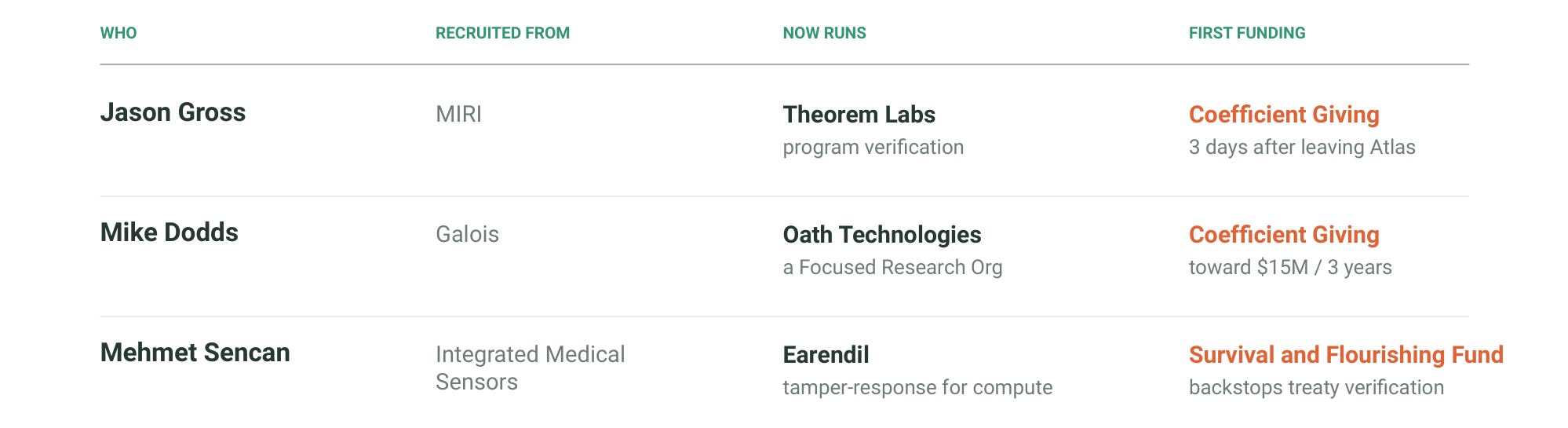
It’s all fine and good to say “let’s invent a new role,” and you should be skeptical. However, over the past three years, we’ve helped bring three entities into existence (Theorem Labs, Oath Technologies, Earendil) in roughly this order: talk to experts, identify a gap, map out the problem space and most promising solutions, find the person best suited to close the gap, and help them get their first funding.
So. Let’s get into it. This post covers:
Why some problems are systematically orphaned.
How field strategy addresses them.
Two requests to help us scale this effort.
Why some problems are systematically orphaned
There are a few reasons:
Mismatch with institutional incentives and mandates.
Mismatch with the instruments we have available.
Mismatch with our individual skill sets.
We saw the first in the opening. The second is known as the law of the instrument. VCs and startup founders assume there’s a product for any problem. Researchers ask whether it would benefit from more research. In both cases, the problems they choose get filtered through “can I apply my tools to this? How could I make it better?” The same goes for traditional funders who issue RFPs. And, of course, for policymakers and standards bodies as well. To a man with a hammer, everything looks like a nail.
This isn’t even a bad thing. Having specialists is great! Lots of problems do, in fact, match someone’s hammer.
However, in our instrument-focused world, you should expect that if most people only look at problems with certain properties, the problems that persist are the ones that can’t be solved by solutions with those properties.
This is not a new observation. Nor is field strategy the only possible solution to it. Focused research organizations (FROs) are a different kind of entity designed to fill another of these gaps.
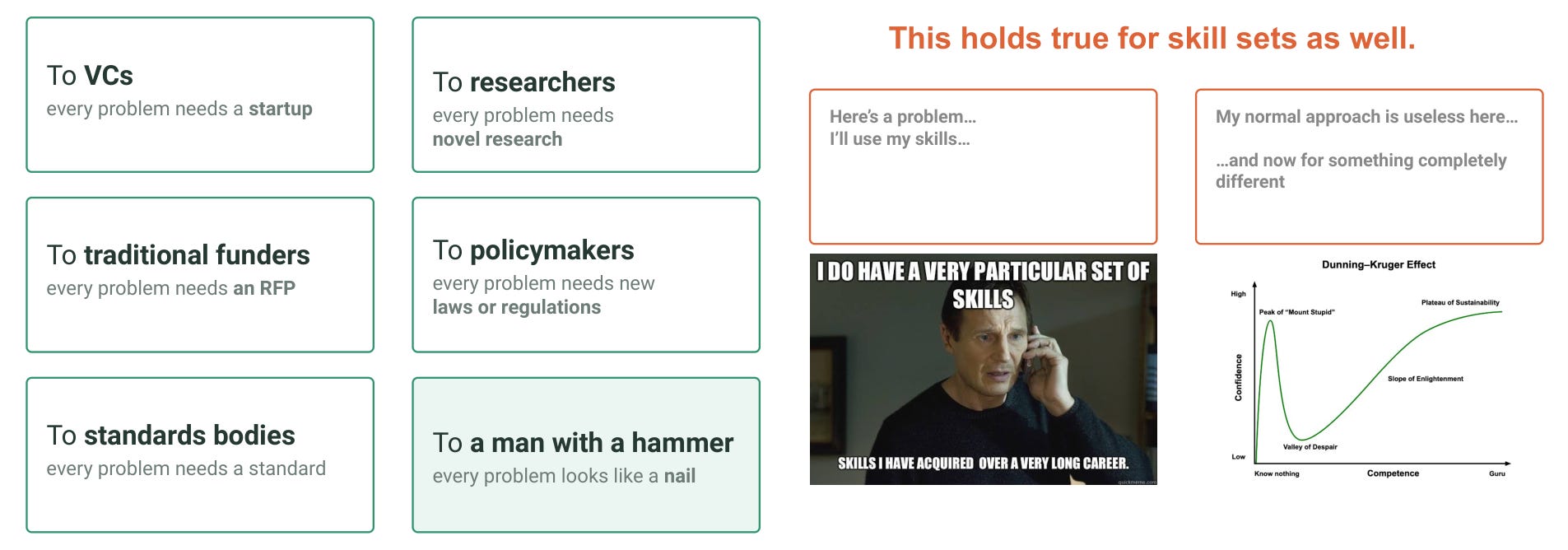
This likewise holds for individual skill sets. People who spot a neglected, important, tractable risk often think, “I’ll use my very particular set of skills on this.” But it’s rarely the case that the person who discovers a problem is also the person with the perfect skills to solve it. Most kidnapping victims are not the children of spies.
Then there’s the opposite move: “my normal approach is useless here, so I’ll become an expert in something completely different.” That risks dramatically underestimating how hard the new field is. But as an old tweet put it, the first step of solving any significant problem is dramatically underestimating how hard it is. There is truth in this. What a generalist really brings is the ability to handle uncertainty: to pursue an important goal through a changing environment when it isn’t clear what “solved” looks like, knowing only the direction of the problem.
So we’ve been trying to work out a process that does not depend on the right generalist stumbling onto the right problem.
How field strategy works: an overview

Let’s start from the assumption that progressively more advanced AI systems will obtain capabilities that create risks for society. If we believe this to be true, then our best course of action would be to understand the scenarios we are most worried about and then identify what defensive equilibria (states of the world) we could move society into ahead of those capabilities coming online, so that when they do, the risks will be mitigated.
Once we know where we want to go, we can then ask: what intervention (concrete action) can we feasibly pursue in the time we have to move us towards that equilibrium, what would it look like to de-risk it, who would have to adopt it, how do we get enough of them to say yes, and how do we get it to the person (or people) best positioned to execute on it?
Let’s walk through how we do that: (1) map how a capability becomes a risk, (2) find candidate defensive equilibria and interventions, (3) scope and de-risk an intervention with domain experts, (4) build the adoption quorum, and (5) staff the problem.
Capabilities do not a risk make
If we want to understand how things could go wrong, it is not enough to forecast that an AI system will be capable of doing X thing by Y date. What we need to know is how that capability (and accompanying vulnerabilities and flaws) is likely to collide with the real world when it does arrive. What actor might exhibit what behavior in which context with what intent? The actor might be a human, an organization, or an agent. Their intentions may be good or bad. For profit, power, or persuasion. And the consequences may affect an individual or civilization.
By holding the capabilities fixed and varying the circumstances we can rapidly explore a multiverse of scenarios. For each one we can assess its severity and likelihood. We can cluster them to identify patterns. And, ultimately, we can determine which risk vectors we should prioritize mitigating. Take the DNA example from the opening. The capability alone (a model that can help design a dangerous genome) tells us little. One scenario that matters is a specific bad actor splitting the order across 100 companies so that no single screener sees the whole sequence. Each prioritized scenario like this becomes the starting point for the next step.
Finding orphaned ideas: victory conditions and tiling trees
What needs to be true about the future world to mitigate the risk? This is our victory condition. Without one, we’d have to smuggle our value judgments into every later choice. Stating the goal up front puts them in one place, where we can see and debate them. If you’re interested in the philosophy behind that, Hume’s guillotine (the is-ought gap) is worth some reading.
The method we advocate is the tiling tree method, popularized by Ed Boyden at MIT and Adam Marblestone, the founder of Convergent Research. The example in their blog post is: how would you record the neural activity of a whole brain at single-cell resolution? It’s a very hard problem. But you can say there are criteria that would have to be true, and split the problem space into options that are mutually exclusive and collectively exhaustive (MECE) at every level of a tree. For example, a recording is either digital or analog. It’s never both, so those two branches cover the space. You keep splitting until you’ve broken the space down into a set of concrete ideas.
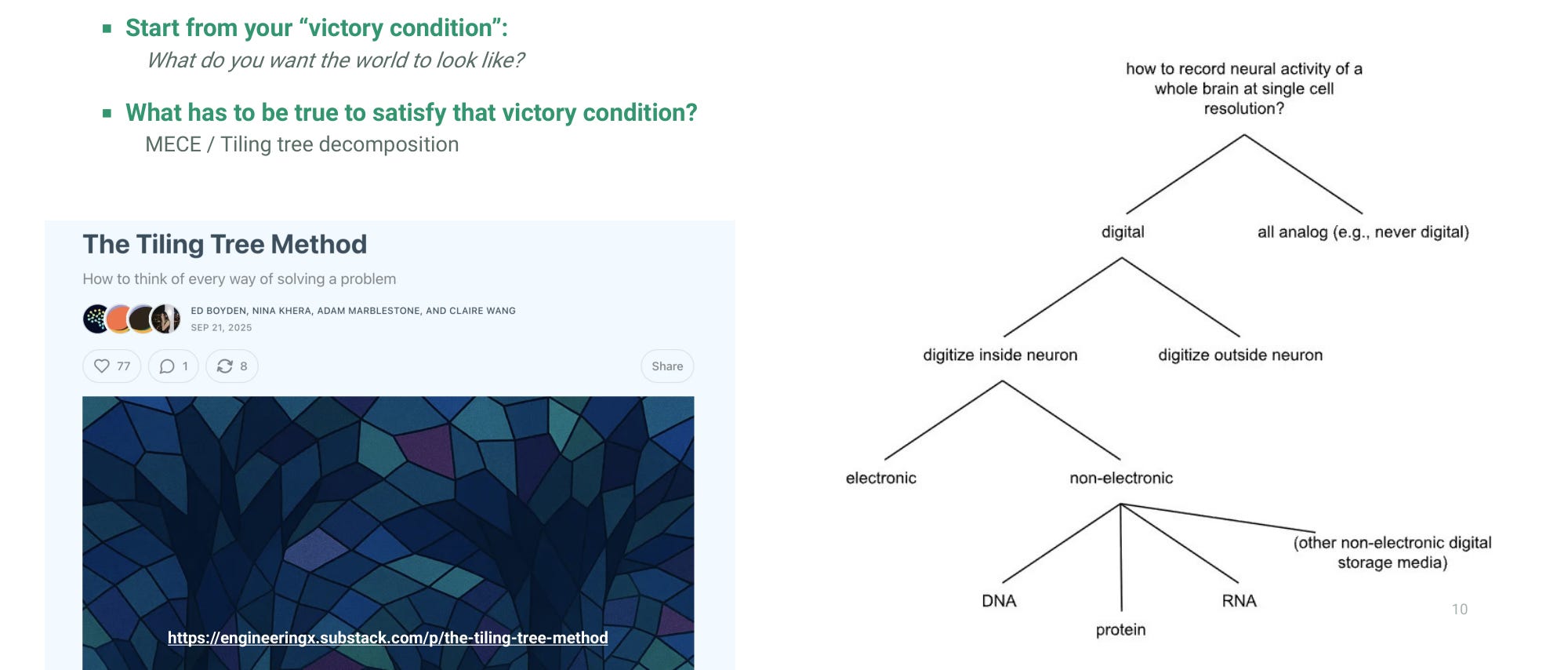
The tree does not need to be a perfect map. Splitting each level so the branches cover the whole space is a discipline for not skipping options, and any ontology we apply will still be wrong somewhere. What we need from this step is enough candidate interventions that at least one turns out to be viable.
So you might say: great, I don’t care about neurons. I care that AI systems follow human instructions and don’t cause societal collapse. In this instance, we might first ask whether the system is following anyone’s instructions. Then whose instructions take precedence, and how that’s decided. Is the user trying to cause harm on purpose, and how do you prevent that? Are they causing harm indirectly, and how would you prevent that?
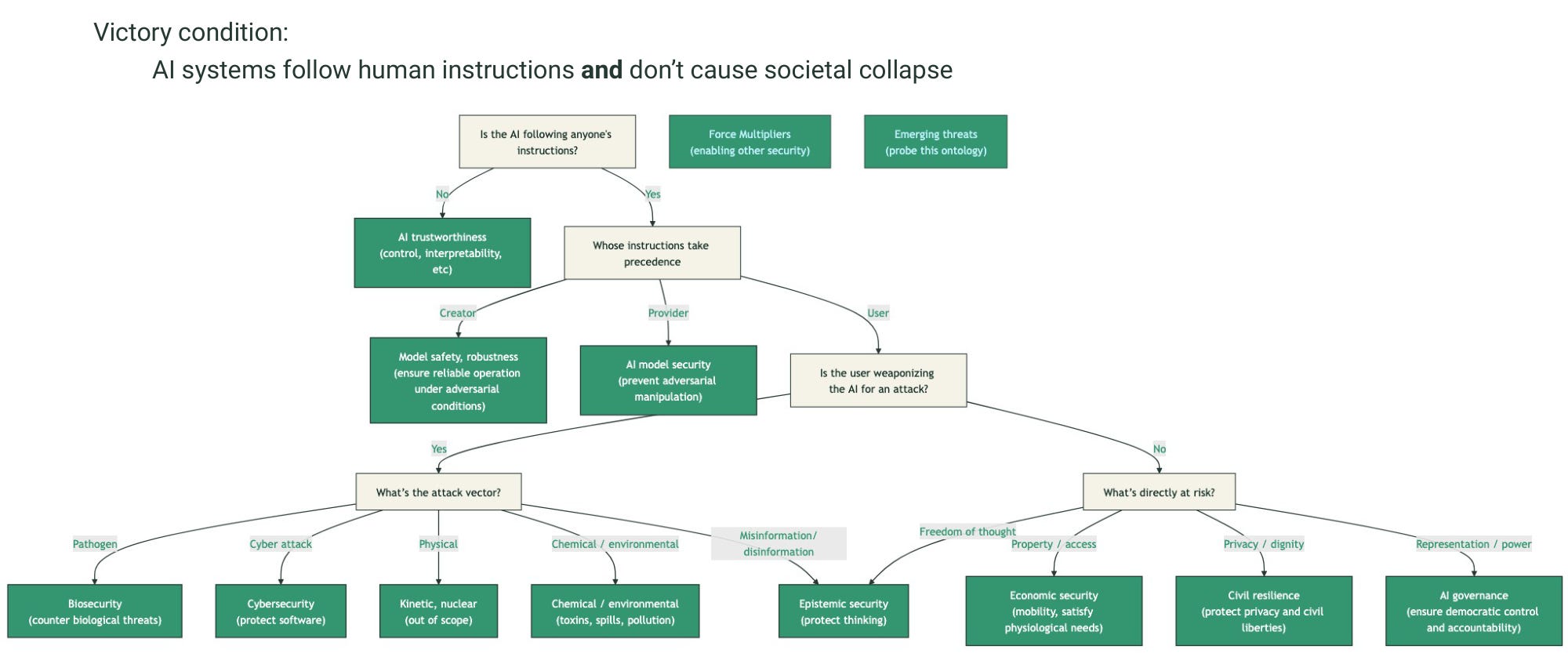
There are many other ways we could break this down. In this instance, the green leaf boxes roughly correspond to subsets of the economy, because those are easier to forecast than, say, all the people in a location, all the people with a particular skill set, or the hardware (a datacenter and its supply chain).
For a really great version of this kind of decomposition, look at Andrew Snyder-Beattie’s four pillars for biosecurity.
Work with experts to scope and de-risk
The natural temptation is to pick your favorite intervention and start building. Or to start pitching to folks that could build it. But the tree only gives us well-reasoned hypotheses. That’s already a lot: it points to opportunities that look impactful and neglected, it keeps track of the alternatives we’ve considered, and it lets us walk into expert conversations with something specific enough to warrant discussion. What it can’t give us is the operational reality of a field, the latent knowledge and unknown unknowns that decide whether an idea is tractable. So we should expect our first proposal to be wrong in ways we cannot see from our desks, and treat finding out why as our job: how would a subject matter expert change the idea so that it would work? If they shared our assumptions and concerns, what would they do instead? Done well, this taps the experts’ expertise and their models of how their domain actually works, and moves us closer to a viable intervention.
Along the way, we should:
Scope a good neglected problem down to a very high-leverage action, rather than jumping straight to “it would be really great if…”
De-risk it with technical experts. Is this possible? Who would have to say it’s possible before a skeptical grantmaker agreed it was worth funding?
Build the adoption quorum: work out who would have to adopt it before it was actually useful. As long as humans are still the meaningful decision-makers, some human will have to choose one thing over another for any work to have impact.
Identify the relevant skills. “Generalist founder” or “general manager” isn’t a job description. You can write a real job description, and that helps you find who could become the founder or general manager.
Figure out why that person, or someone of that archetype, would say no, and what it would take for them to say yes.
Building the adoption quorum
The step that most separates field strategy from writing a white paper is building the adoption quorum: the set of people who would need to say yes for the intervention to work. Our job is to identify whose participation is necessary, learn their incentives and constraints, test whether a viable path to adoption exists at all, and then cultivate the relationships, commitments, and community that get enough of them to yes. That includes identifying and preparing the organization that will house the intervention and the person who will lead it. We need to come to the adopters with “this solves a problem for you,” not “please do this because it would be good.” The best thing to have in hand before handoff is a set of conditional commitments: “if this entity existed, and a person matching this profile were leading it, we would join.” Those commitments solve the bootstrapping problem, both for the adopters and for the founder we are about to recruit.
Worked example: verifying a datacenter only runs inference
In the future, we might want to verify that a datacenter is only being used for inference, or only for alignment research. Some policy choices will depend on how costly that verification is perceived to be. If it looks like it would take years to set up and wouldn’t be very reliable, it might not happen. If it looks like a software update that could be done within a week, a human decision-maker is much more likely to say, “Okay, let’s actually enforce this.” So the question is how to reach an equilibrium where requiring restrictions on non-inference compute becomes an easy choice.
You can roughly break this down into three possible options:
People check the machines directly.
People check the machines using existing trusted machines (satellites or telemetry).
People build new trusted machines and put them in the datacenters.
The last is, by far, the most reliable. And it’s likely the only option that would meet the security requirements. Though there might be other options worth exploring.
Suppose we start with that last option: workload attestation on-chip, assuming there’s something you can leverage to get cryptographic attestations of what’s running. Does this mean updating the hardware itself and getting NVIDIA to change what it’s doing? There are likely people at frontier labs who could ask for changes in hardware to be deployed if those changes met certain criteria. What are those criteria? That may be unclear to us now, but it is a thing that a field strategist could track down. There’s also the question of whether you can bolt on new hardware, such as a tamper-proof, verifiable network monitor. And there’s the question of whether we should just do the best we can with software.
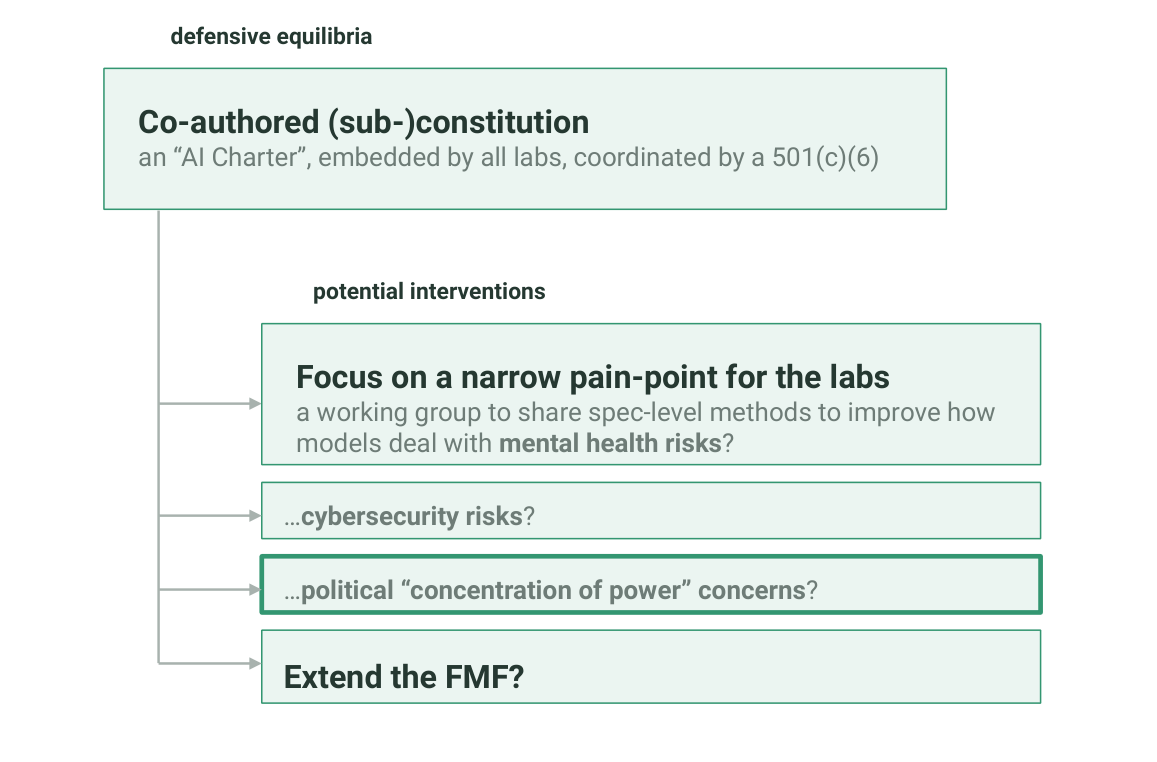
We’ve spent a decent amount of time thinking about the first option (updating the hardware) and are talking to people more and more about the other two. If you dig into the first, there are roughly three ways it might get adopted:
Economic incentives. Datacenter providers have real economic reasons to offer exactly the security guarantees you’d want for verifiable monitoring. That might look like formally verified isolation of processes. On the finance side, you know your agents can’t modify the billing. On the verification side, you know the agents and other applications can’t tamper with what the monitoring sees.
Regulatory requirements. That’s a very different adoption path. If there were signals of upcoming regulations, you might get meaningful changes to hardware, but it’s a very different incentive problem and a very different adoption quorum.
Frontier labs. The labs could say they want this and require it of their inference datacenters, so they can coordinate with each other in a trustworthy way.
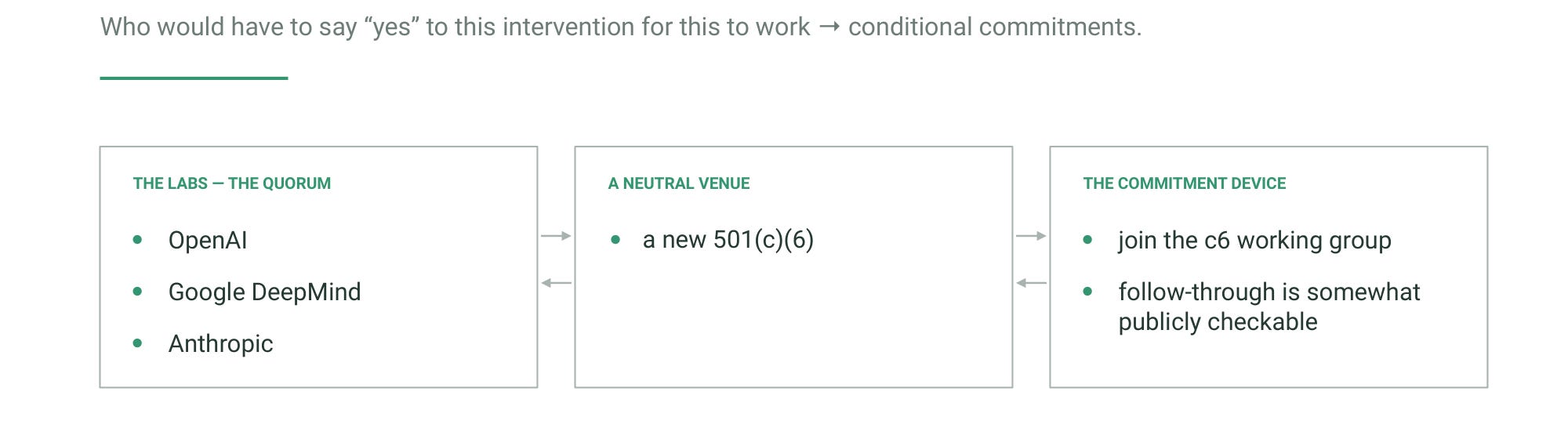
Any one of these quorums would be enough. It isn’t clear which is closest to yes, and figuring that out is both necessary for adoption and hard to automate. So a significant part of the actual human labor of field strategy is this. Thankfully, current models are good enough to help you identify the quorums, the people in them, and what their incentives might be. The bigger part, inevitably, is going to talk to those people about what their incentives actually are, or hiring field strategists who’ve worked in those areas, who know the incentives, can model them well, or can get the right people on the phone quickly.
Alongside quorum-building runs technical de-risking, which might take the form of a Google Doc you socialize. In this case it could take the form of an advance market commitment for formally verified AI containment for cloud infrastructure providers, verified from the hypervisor all the way down to the gates. It says there should be a tool with these properties, and that if it had them, we’d pay this much for it. The goal is to put the right decision-makers in a room and ask: can we agree on something? Can we use philanthropic funding to subsidize the existence of this tool? There are enough startups and contractors who would build it if they knew exactly what it took to get adopted by the cloud providers. Solving that coordination problem (what needs to be done, what the product requirements doc says for a thing that doesn’t exist yet) is necessary before you can staff the effort.
Speaking of…
Staff the problem
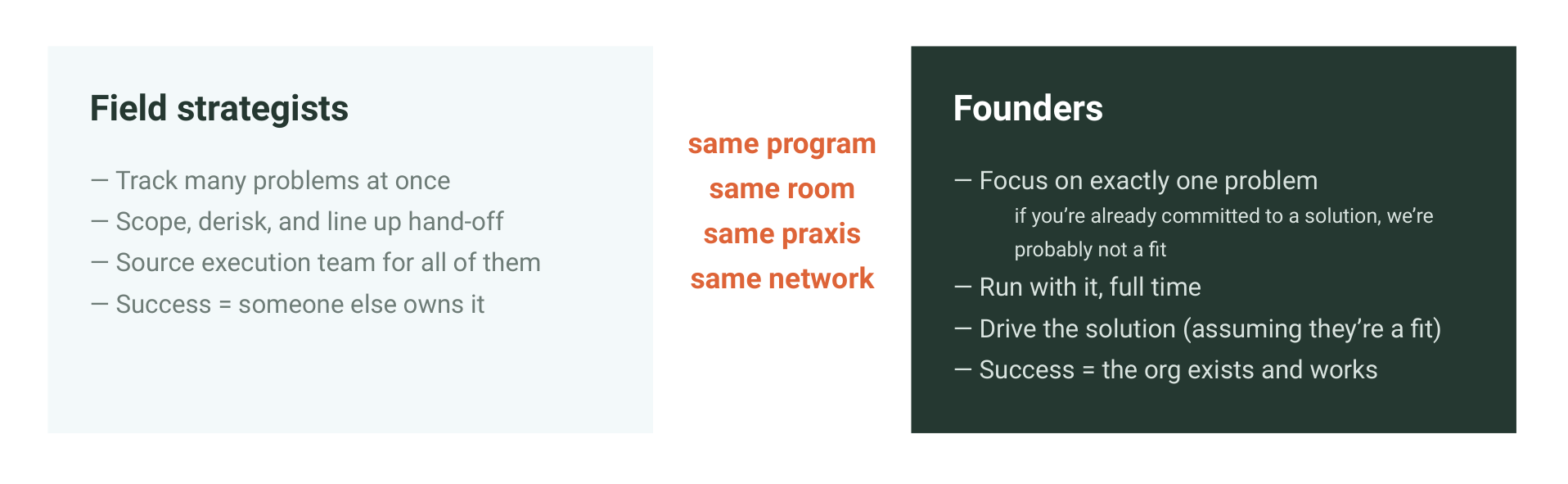
The last step is to staff the problem. Field strategists differ meaningfully from founders. They do much of the strategy that makes it easier to find a founder and easier for that founder to start and succeed, and then they hand off and do it again.
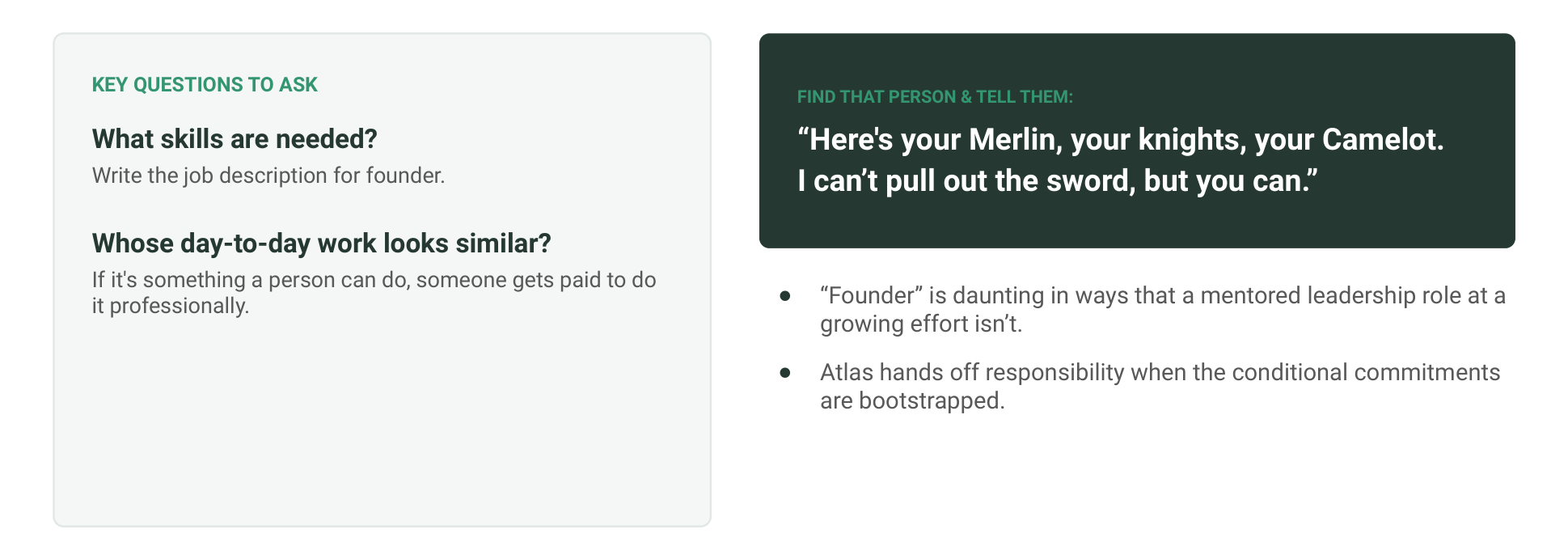
When you staff a problem, ask what skills are needed and write the job description. Work out what the day-to-day work of the person doing it looks like, then find out who in the world has a job whose day-to-day looks basically the same. This is one of the most interesting lessons from Convergent Research. Of the dozen or so FROs that have started, nearly all are roughly 20% visionaries and 80% people who’ve been doing almost exactly the same thing for the last 10 to 20 years of their careers, now doing it in a different context toward a new end. The work itself looks very much the same. Their expertise as, say, a hard-vacuum engineer is the only thing that matters, and you need to import exactly that expertise.
It is likely that anything a person can do, someone out in the world is getting paid to do professionally. The world is big and weird. The goal is to find that person, or the best of those people, and find out why they aren’t working on this problem and why they wouldn’t say yes if you handed them all the progress you’ve made.
The founder role is daunting in ways that taking on a problem a field strategist has already developed, and already gathered conditional commitments for, is not. And it’s very compelling to be on the other end of a call where someone says: “Somehow, without your knowledge, you’ve become the perfect person to run this effort. Do you want to do it? I can give you all of these things, but I can’t do the work myself because I don’t have the expertise. You’re one of four people in the world who seem to have it, and you’re the first one I’m talking to.”
Limitations of this process
You should be deeply skeptical of anyone who arrives with a panacea and claims it solves everything, and this process has obvious limitations:
It doesn’t work if you don’t know what good looks like. Where there’s a ton of uncertainty, as in alignment research, we don’t know what good or done looks like, so we can’t run this process. It’s also very hard, if possible at all, where iteration is very costly.
Sometimes you really do need a unicorn generalist founder, who may not exist.
Having a process for identifying candidate solutions doesn’t mean a viable solution exists. There’s no rule that says we make it.
Sometimes no adoption quorum is reachable. The people who would have to say yes may have no reason to, or none that arrives in the time available. Finding that out early is still useful, but it does mean the intervention may not be viable.
Nice properties of this process
There are also some nice properties:
It is intervention-agnostic. We start from a risk or a desired outcome instead of a preferred solution, and let evidence and stakeholder input narrow the options. That makes us less likely to anchor on interventions that happen to fit our own skills, interests, or institutional incentives. And since a field strategist expects someone else to execute, there is little pull toward whatever they personally are positioned to build.
The interventions are shaped by the experts who know the domain. Whenever an expert says “that’s dumb, you should be doing this instead,” the obvious response is: “If you had these constraints, this goal, and these assumptions, how would you solve it?” They basically do your job for you, and they’re proud to disabuse you of your ignorance. Some want to keep doing it, and eventually you may have someone who feels a large and justified sense of ownership over the solution you designed together.
It answers the ownership objection. People worry that great founders don’t want to be handed a solution; they want ownership of developing it. It turns out that if you’ve been talking with the same person for three months while scoping and de-risking, they’ll probably feel a lot of ownership over that solution direction. And you can ask them directly: “What would it take for you to say yes to running this? Is there an amount of money, support, ownership, or de-risking that would get you to leave your current job? Where’s that line?” Worst case, they tell you there isn’t one. But usually, putting them in the mindset of solving this as a problem ends with them negotiating against their own status quo in favor of change.
Picking cause areas, scoping interventions, and executing are separated. You get specialization of labor and bigger talent pools. For the governance nerds: whatever its flaws, futarchy (Robin Hanson’s idea that lawmakers set goals and prediction markets decide which policy best achieves them) gets one thing right. It separates the two halves of governance: deciding what good is, and picking the path that best achieves it. Today those are tangled together in both grantmaking and policymaking. Field strategy gives you the same kind of separation.
Where we find field strategists
As for widening the talent pool, the relevant field strategy skills are things like figuring out who the decision-makers are, getting into the room, persuading them, modeling their incentives, and having experience in the relevant industry. We’re recruiting from:
think-tankers frustrated that the work stops at the white paper;
management consultants who have lots of boardroom experience and want to put it toward a good cause;
people in government frustrated by policy swings or the limits of existing state capacity;
former founders and product managers, especially those who love the strategy side of the job and really want to have impact.
An incubator with field strategy characteristics
At Atlas, we’re doing this as a combined field strategy and incubator structure. We have founders in residence, who each focus on exactly one problem and see it through until it leaves Atlas, and field strategists, who work on multiple problems in parallel and focus on handing them off. They’re in the same room, with access to the same professional network, using the same internal agentic processes, workflows, and tools.
Two requests
If this resonates, we would ask the following:
Send us field strategists. If you know someone who’d be great at the work described above (scoping a problem, de-risking it, getting the right people to say yes, then handing it off), or that’s you, please get in touch. Think-tankers, consultants, people in government, product managers, and former founders are all good fits, and people with networks at frontier labs or in the safety community are especially valuable.
Send us neglected problems and orphaned solutions. If you’ve run into an AI risk that no existing institution is built to address, or a solution that everyone agrees should exist but that isn’t anyone’s job to build (not a startup, not a research project, not a policy fight), we’d love to hear about it.
A note from Atlas: we’re starting this blog back up. Some upcoming posts will be ideas that have been sitting on the shelf and are finally getting written up. We’ll also be sharing much more about the automated field strategy tooling we’re building. Stay tuned.